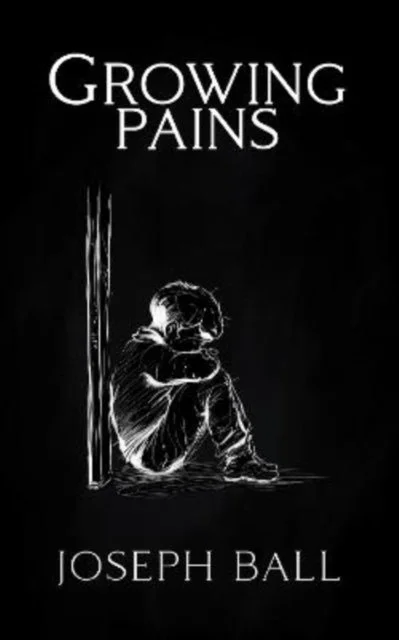
Growing Pains by Joseph Ball
This powerful novel follows eleven-year-old Alexander through his first year at secondary school in the 1990s. It is not always an easy read, as it deals with the emotional abuse and neglect of a child, but it is an important story to tell and one that is handled with care and authenticity. One of the most striking aspects of the book is the decision to tell the story almost entirely from Alexander’s point of view. Experiencing events through his eyes makes everything feel immediate and deeply personal. His confusion, hurt, and attempts to make sense of the world around him are portrayed in a way that feels painfully real.
From the opening chapter it becomes clear to the reader that things are not quite what they seem in Alex’s home life. To the outside world he appears to have a loving mother, a father who takes him to football every week, and plenty of computer games for his birthday. What the novel does particularly well is highlight how difficult emotional abuse can be to recognise. Alex’s father, Jason, is especially good at hiding the worst of his behaviour from others — even Alex’s mother, Helen. Over the course of the year, we watch Alex’s confidence completely stripped away by Jason’s controlling and bullying behaviour, until he is forced to spend days wandering the streets because he no longer feels safe at home.
Helen is a complex character and one I would have liked to understand more fully. It is obvious that she dotes on Alex, yet at the same time she encourages him to adjust his behaviour to keep Jason happy. For that reason, I sometimes found myself wishing we could glimpse the story from her perspective — and perhaps even from Alex’s sister’s — as I suspect their lives were far from untouched by Jason’s controlling behaviour. That said, I completely understand why the author chose to stay so firmly within Alex’s viewpoint; it gives the story its emotional punch and authenticity.
There are some glimmers of hope for Alex throughout the book; a local librarian and relatives in Devon help him begin to realise that his home life is not normal. However, as this is only the first book in a series following Alex’s journey to adulthood, the story ends with his story very much still unfolding. As I finished the book, I was keen to know what happens next, and I’ll be interested to see how his experiences shape the person he becomes in future books.
Richard